
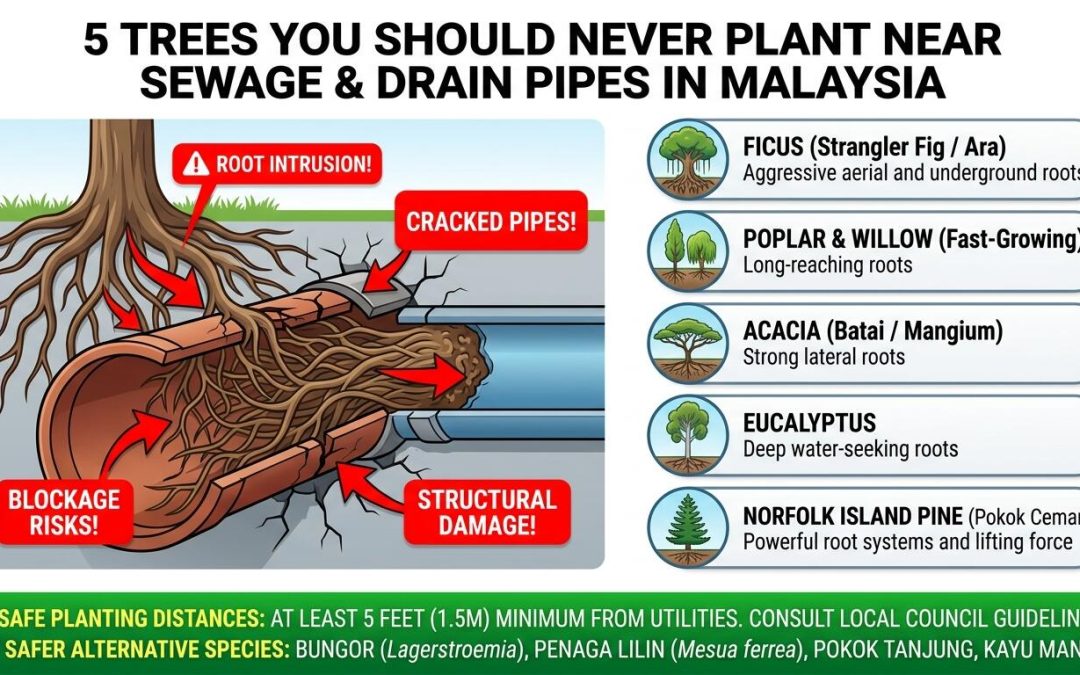
Malaysian homeowners love lush gardens, and the tropical climate fuels rapid growth—but it also encourages aggressive roots that devastate underground infrastructure.
Sewage and drainage pipes are especially vulnerable. When roots infiltrate, results range from slow drains to complete blockages and costly structural failures. Research shows maintenance costs for affected pipes can rise four to six times compared to undamaged infrastructure. Many councils also regulate tree planting near drainage reserves—the wrong species can lead to enforcement action and mandatory removal.
This article identifies five trees never to plant near sewage and drain pipes in Malaysia, why they cause problems, and safer alternatives for responsible landscaping.
Why Tree Roots Invade Sewage and Drain Pipes
Tree roots don’t actively seek pipes—they grow toward moisture and nutrients. In Malaysian soil, pipe trenches channel water, and any minor crack, loose joint, or worn seal lets moisture escape, attracting fine feeder roots through openings as small as a hairline fracture.
Once inside, roots find continuous water and organic matter, proliferating rapidly into dense masses that restrict flow and cause blockages. Growing roots widen cracks, leading to pipe collapse.
Research shows even small cracks release enough water vapour to attract aggressive species—making species selection one of the most critical decisions for property owners.
Understanding Malaysian Guidelines for Tree Planting Near Utilities
Before planting any tree, know local regulations.
Under the Street, Drainage and Building Act 1974 (Act 133), Section 38, no tree may be planted within twelve feet of any road or back lane without local authority permission. Some councils, like Penang Island City Council, require trees at least 5 feet from water pipes and utilities—and prohibit planting directly over concrete pipes.
Enforcement is common. In one Hulu Selangor case, a resident was ordered to remove a tree on government reserve land within 14 days, with threats of fines and prosecution.
These rules reflect a simple reality: tree roots and underground infrastructure clash when distance and species selection are ignored.
The 5 Trees to Avoid
1. Ficus Species (Ficus spp.) — The Strangler Fig
Local names
Ara, Jejawi, Bunut
Ficus species are among the most problematic trees for underground infrastructure in Malaysia and tropical regions worldwide. The genus includes large trees with extensive, aggressive root systems that travel significant distances seeking moisture.
Research on Malaysian heritage building environments specifically identifies Ficus species as having adventitious roots that threaten drainage channels, roof gutters, and structural elements. The aerial roots characteristic of many Ficus species can also descend and penetrate underground pipes when they reach soil level.
Why they are dangerous
Ficus roots are opportunistic and aggressive. They exploit any weakness in pipe joints and expand rapidly once inside. Some species can grow into strangler figs, eventually enveloping structures with a network of roots that pry apart masonry and underground connections.
Alternative
If you want the lush foliage of a Ficus without the risk, consider smaller ornamental varieties grown in large containers, or select non-invasive species suited to Malaysian conditions.
2. Poplar and Willow (Populus spp. and Salix spp.)
Local names
Various; Poplar species are sometimes planted as ornamentals
European and North American research consistently identifies Populus and Salix as having the highest potential for root intrusion into pipes. While less common in Malaysian gardens than Ficus, they’re occasionally planted for rapid growth and ornamental value.
These species’ root systems are notorious for seeking water sources, including leaking pipes. A historical study documented poplars breaking sidewalks and causing infrastructure conflicts in Canadian prairie cities as early as the 1930s.
Why they are dangerous
Poplar and willow roots are extensive, fast-growing, and highly attracted to moisture. In Malaysian conditions with consistent rainfall, these trees can develop root networks that quickly find and exploit any pipe vulnerabilities.
Alternative
For rapid shade in Malaysian gardens, consider native species with more contained root systems, such as certain Syzygium (Kelat) varieties, which are recommended for urban planting in Malaysia .
3. Acacia and Related Legumes (Acacia spp., Albizia spp.)
Local names
Acacia (Mangium), Batai
Acacia mangium has been widely planted in Malaysia for timber and reforestation. While valuable for forestry, it’s a poor choice near residential drainage infrastructure.
Acacia and Albizia species develop extensive lateral root systems. A Malaysian study of heritage building environments classified woody plants with lateral roots as threatening to building structures, including walls, floors, and drainage systems.
Why they are dangerous
These fast-growing trees require substantial water and nutrient uptake. Their root systems spread widely in search of resources, making them likely to encounter and invade underground pipes. The aggressive growth habits that make them valuable timber species also make them problematic near utilities.
Alternative
For similar growth habits without the infrastructure risk, consider Tembusu (Fagraea fragrans) or other native Malaysian trees with more predictable root behaviour. FRIM recommends species like Bungor (Lagerstroemia sp.), Penaga Lilin (Mesua ferrea), and Pokok Tanjung (Mimusops elengi) for urban planting .
4. Eucalyptus Species (Eucalyptus spp.)
Local names
Eucalyptus, Kayu Putih
Eucalyptus species have been introduced to Malaysia for plantation forestry and ornamental purposes. However, Australian research found Eucalyptus and Melaleuca caused the highest percentage of root intrusions in a study of 123 cities—though researchers noted this may reflect how frequently they’re planted.
Eucalyptus roots are adapted to survive harsh conditions, including drought. This makes them particularly prone to seeking out moisture sources, including leaking pipes.
Why they are dangerous
Eucalyptus trees develop deep and extensive root systems. Their roots are efficient at locating water, and they can exert significant pressure on pipe walls as they grow. Additionally, the leaf litter from many Eucalyptus species is allelopathic, inhibiting growth of other plants and creating maintenance challenges.
Alternative
For properties where a tall, graceful tree is desired, consider native Malaysian species that are adapted to local conditions without posing excessive risk to underground utilities.
5. Norfolk Island Pine (Araucaria heterophylla)
Local names
Pokok Cemara, Norfolk Island Pine
The Norfolk Island Pine is a popular ornamental tree in Malaysian coastal areas and gardens, valued for its symmetrical shape. But its root system is far more extensive than its graceful appearance suggests.
A tree assessment report documented Norfolk Island Pine roots damaging retaining walls and threatening septic tank infrastructure, with potential for pipe rupture and sewage spillage. That tree stood 25 metres tall, with roots extending well beyond the canopy line and exerting mechanical lifting forces on surrounding structures.
Why they are dangerous
Araucaria heterophylla develops large, woody roots that can extend significant distances from the trunk. These roots are capable of exerting powerful lifting forces that can crack pipes, lift pavement, and damage foundations. In Malaysian coastal areas where this species is commonly planted, the combination of sandy soil and extensive root growth creates particular risk for underground utilities.
Alternative
For coastal Malaysian gardens, consider Barringtonia asiatica (Putat Laut) or Terminalia catappa (Ketapang), which have more manageable root systems while providing similar aesthetic value.
How to Protect Your Pipes When Planting Trees
If you want to plant trees but also protect your underground infrastructure, consider these strategies:
- Install physical barriers, such as polyethylene root panels, can be installed between trees and pipes at the time of planting
- Maintain safe minimum distances, for water pipes and utilities, a distance of at least 5 feet is advised
- Choose appropriate species with non-aggressive root systems, including Bungor, Penaga Lilin, Pokok Tanjung, Kayu Manis, and certain Diospyros (Kayu Arang) species
- Avoid planting over pipes directly above sewer or drainage lines, regardless of species
- Regular inspection, especially if you have mature trees on the property
Conclusion
Tree root intrusion is preventable. Five species—Ficus, Poplar/Willow, Acacia, Eucalyptus, and Norfolk Island Pine—cause disproportionate underground damage due to their aggressive, water-seeking roots.
For Malaysian property owners, the solution is informed species selection: choose trees with non-aggressive roots, keep safe distances from utilities, and consider root barriers. FRIM and municipal guidelines offer valuable guidance.
A beautiful garden and reliable plumbing aren’t mutually exclusive. With careful planning and the right species, you can enjoy trees while protecting the infrastructure beneath your property.
FAQs
1. Which trees are most dangerous for sewage pipes in Malaysia?
Ficus species, Poplar, Willow, Acacia, Eucalyptus, and Norfolk Island Pine are among the most problematic. These trees have aggressive root systems that seek out moisture and can infiltrate pipes through small cracks or loose joints. Local Malaysian guidelines also warn against planting large tree species near drainage reserves and utilities .
2. How far should trees be planted from sewage pipes?
Malaysian municipal guidelines generally recommend a minimum distance of 5 feet between trees and water pipes or utilities . However, this distance is the absolute minimum and larger trees with extensive root systems require significantly greater separation. For large species, a distance of 10 metres or more is advisable. Always check with your local council for specific requirements.
3. Can tree roots really break concrete pipes?
Yes. While roots typically enter through existing cracks or joints, once inside, they can expand and exert pressure that widens cracks. Over time, this can lead to pipe collapse. The mechanical lifting action of large roots can also crack pipes from the outside, especially in shallow installations .
4. What should I do if I suspect root intrusion in my pipes?
Contact a qualified plumber or drain specialist immediately. They can use CCTV inspection to confirm the presence of roots and assess damage extent. Early intervention—such as mechanical root cutting or chemical treatment—is far less expensive than emergency repairs after a complete blockage or pipe collapse.
5. Are there root barriers I can install myself?
While DIY root barrier products exist, professional installation is recommended for effective protection. Barriers must be installed to sufficient depth and positioned correctly to intercept roots. Malaysian planting guidelines recommend polyethylene root barriers for trees near drains . Improper installation may simply redirect roots rather than stop them.