
Trees enhance the beauty of Malaysian neighbourhoods, providing shade, cooling effects, and environmental benefits. However, when a neighbour’s tree branches extend over your property line, they can create real problems—falling leaves clogging drains, obstructed sunlight, potential damage to your roof, or safety concerns during storms.
Many homeowners in Malaysia face this situation and wonder: Can I cut the branches myself? Who is responsible for the damage? Should I complain to the local council?
These are common questions with no simple answers, because Malaysian law addresses tree disputes through several different angles—local council regulations, land law principles, and even religious guidance. Understanding which rules apply to your situation is the first step toward resolving it.
This guide explains your options, your legal rights, and the practical steps you can take when dealing with overhanging tree branches from a neighbour’s property in Malaysia. Whether the branches pose an immediate danger or a gradual nuisance, knowing the right approach can save you time, money, and neighbourly relationships.
Understanding the Legal Position on Overhanging Branches
Under Malaysian law, overhanging branches that interfere with your use and enjoyment of your property may constitute a nuisance. While you may have the right to take legal action, the costs and time involved often make this an impractical first step.
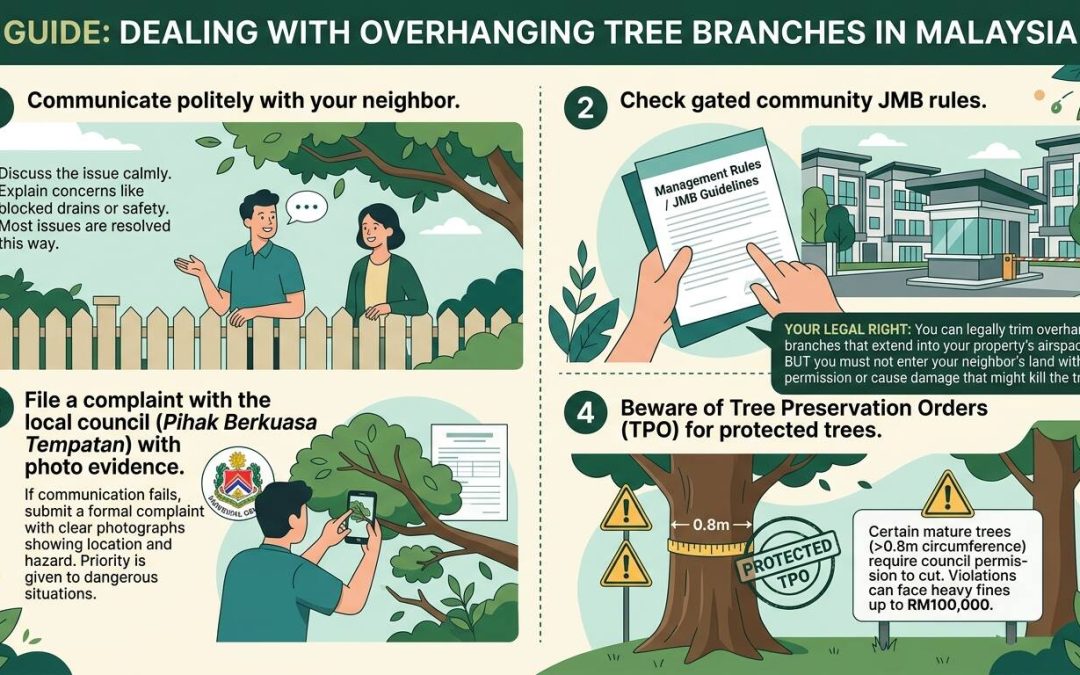
The general principle is that you have the right to cut branches that extend into your property’s airspace. However, this right comes with important limitations. You must not damage the tree itself during pruning, and you cannot enter your neighbour’s property without permission to cut branches.
The Street, Drainage and Building Act 1974 (Act 133) addresses trees bordering roads and public areas. Section 36 empowers local authorities to issue written notices requiring property owners or occupiers to trim or cut any trees or branches overhanging any road or public pathway. While this specifically addresses public roads, it establishes the principle that property owners are responsible for maintaining their trees to prevent public hazards.
Step-by-Step: What You Should Do
1. Communicate with Your Neighbour First
Before taking any other action, approach your neighbour politely and explain the issue. In many cases, neighbours are unaware that their tree is causing problems. Malaysian property law emphasizes the importance of resolving disputes through communication and neighbourly cooperation.
Document your concerns clearly—whether it’s falling branches posing safety risks, blocked gutters, or damage to your property. Request that they arrange for proper pruning or maintenance.
2. Check Your Community Rules
If you live in a gated community or a managed property with a Residents’ Association or Joint Management Body (JMB), check the community rules. Some residential areas have specific provisions regarding tree maintenance and cost-sharing for tree-related issues.
3. File a Complaint with Your Local Council
If direct communication fails, or if the tree poses an immediate danger, you can file a complaint with your local authority (Pihak Berkuasa Tempatan). Local councils in Malaysia have the authority to handle tree-related complaints and can order tree maintenance when public safety is at risk.
According to guidelines from local councils, you should provide:
- Clear photographs of the overhanging branches
- The exact location of the tree
- The nature of the hazard or inconvenience
- Your contact information
For example, the Subang Jaya City Council (MBSJ) encourages residents to submit complaints with clear photos to help identify the location and risk level accurately.
A local councillor in Muar emphasized that residents should not attempt to solve tree problems themselves through methods like burning or poisoning, as this creates additional safety hazards and legal complications.
4. What If the Tree Is Protected?
Some trees in Malaysia are protected under Tree Preservation Orders (TPO) issued under the Town and Country Planning Act 1976 (Act 172). Trees with a circumference exceeding 0.8 meters generally cannot be felled without permission from the local authority, except in specific circumstances such as when the tree is dead or poses imminent danger.
If your neighbour’s tree is a protected species or falls under a TPO, the local council must be involved in any decisions regarding pruning or removal. Cutting such trees without authorization can result in fines up to RM100,000 or imprisonment.
Understanding Liability for Damage
If a neighbour’s tree falls and damages your property, liability can be complex. Malaysian law recognizes that local authorities have a statutory duty to maintain trees under their jurisdiction, especially those that could endanger public safety.
Recent court cases have established that local authorities can be held liable for failing to supervise and maintain trees, even those located on private property, when they pose a threat to public safety. However, this doesn’t absolve property owners of their responsibility to maintain trees on their land.
The principle of shared liability applies in many situations: property owners must maintain their trees responsibly, while local authorities must take action when notified of hazardous conditions.
When to Hire a Professional Arborist
If the overhanging branches require significant pruning, or if the tree appears unhealthy or structurally unstable, hiring a certified arborist is strongly recommended. Professional tree care services can:
- Assess the tree’s health and structural integrity
- Perform proper pruning techniques that won’t harm the tree
- Identify potential hazards like internal decay or root problems
- Provide documentation that may be useful in disputes
The Jabatan Landskap Negara (National Landscape Department) has published guidelines and manuals for amenity tree pruning that serve as the standard for tree care in Malaysia.
Document Everything
Regardless of how you proceed, maintain detailed records:
- Dates and descriptions of conversations with your neighbour
- Photographs of the overhanging branches (with dates)
- Copies of any complaints filed with the local council
- Receipts for any professional services you arrange
- Records of any damage caused by the tree
This documentation will be valuable if the dispute escalates or if you need to file an insurance claim.
Preventing Future Disputes
The best approach to tree-related neighbour disputes is prevention. Consider these proactive measures:
- Maintain open communication with your neighbours about tree concerns
- Arrange for regular professional tree inspections
- Address minor issues before they become major problems
- Understand and respect the legal rights of all parties involved
Trees are valuable community assets, but they require proper management to ensure safety and prevent conflicts between neighbours.
Conclusion
When a neighbour’s tree branches overhang your yard in Malaysia, you have options ranging from direct communication to filing complaints with local authorities. While you generally have the right to trim branches that cross into your property, this must be done carefully and without damaging the tree or trespassing.
For significant issues or safety concerns, involving your local council or a certified arborist is the safest and most effective approach. Understanding both your rights and your responsibilities will help you resolve the situation while maintaining good neighbourly relations.
If you’re concerned about the safety of overhanging trees on your property or a neighbour’s tree, consider arranging a professional tree risk assessment. Our experienced team provides tree inspections, pruning, and maintenance services to keep your landscape safe and healthy.
FAQs
1. Can I legally cut my neighbour’s tree branches that overhang my property in Malaysia?
Yes, you generally have the right to cut branches that extend into your property’s airspace. However, you must not damage the tree, and you cannot enter your neighbour’s property without permission to do so. For significant pruning or if the tree is protected under a Tree Preservation Order, consult your local council first.
2. Who is responsible if a neighbour’s tree falls and damages my property?
Liability depends on several factors, including whether the tree was properly maintained and whether the owner was aware of potential hazards. Local authorities also have statutory duties to maintain trees that pose public safety risks. In practice, liability may be shared between the property owner and the local authority. Consult a legal professional for specific advice.
3. How do I file a complaint about a dangerous tree in Malaysia?
Contact your local municipal council (Majlis Perbandaran or Dewan Bandaraya) through their official complaint channels. Provide clear photographs, the exact location, and a description of the hazard. Local councils prioritize complaints based on risk level and can issue notices to property owners to take action.
4. What if the tree is protected under a Tree Preservation Order?
If the tree has a circumference exceeding 0.8 meters or is otherwise protected, you cannot cut it without permission from the local planning authority. Exceptions exist for dead or imminently dangerous trees, but documentation is required. Contact your local council before taking any action.
5. Should I hire an arborist or just cut the branches myself?
For small branches that you can safely reach without damaging the tree, DIY pruning may be acceptable. However, for larger branches, trees near buildings or power lines, or any tree showing signs of disease or instability, hire a certified arborist. Improper pruning can kill the tree, create liability issues, and potentially cause accidents.