
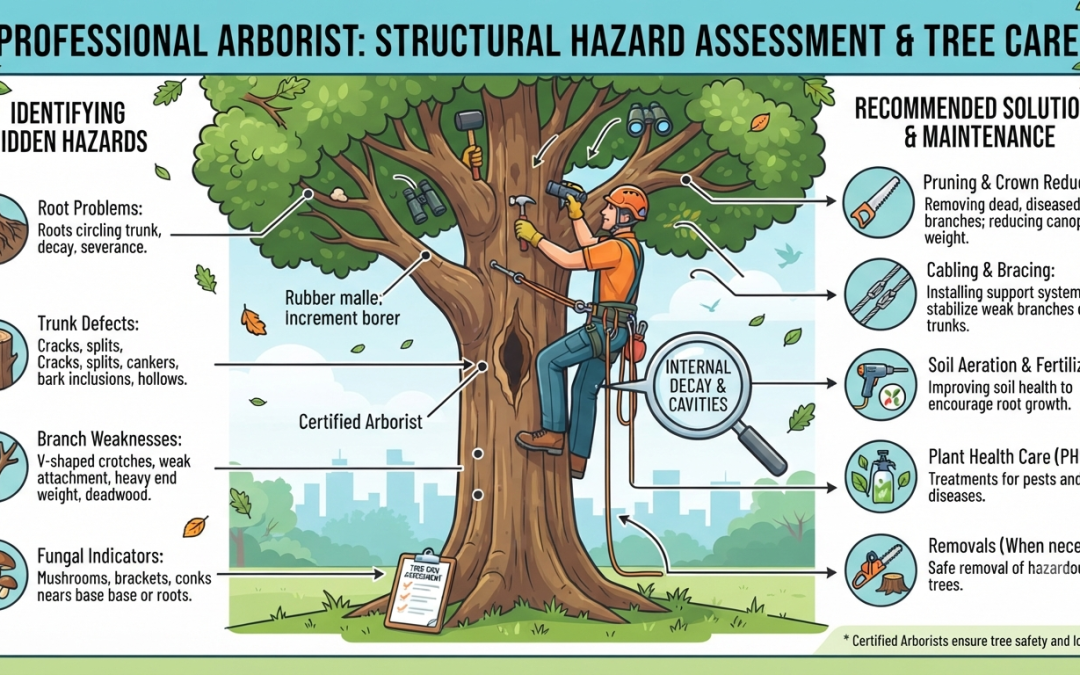
Trees enhance residential, commercial, and public landscapes by providing shade, improving air quality, increasing property value, and creating a healthier environment. While healthy trees are valuable assets, trees with hidden structural problems can become serious safety hazards if left undetected. Many dangerous tree conditions develop gradually and are not immediately visible to property owners.
A tree may appear healthy from the outside while internal decay, weakened branches, damaged roots, or structural defects continue to develop beneath the surface. Without professional inspection, these hidden problems can eventually lead to falling branches, tree failure, property damage, or personal injury.
Professional arborists are trained to identify these hidden hazards before they become dangerous. Through detailed tree inspections, specialised knowledge, and professional assessment techniques, arborists help property owners make informed decisions about tree maintenance, pruning, treatment, or removal.
Understanding how professional arborists identify hidden tree hazards highlights the importance of regular tree inspections as part of responsible property maintenance.
Why Hidden Tree Hazards Are Often Difficult to Detect
Many tree problems develop internally long before visible symptoms appear.
Unlike broken branches or obvious storm damage, hidden hazards may remain unnoticed for months or even years.
Some problems occur beneath the bark, inside the trunk, or below ground within the root system.
Because these issues are not always visible to the untrained eye, trees may continue to appear healthy despite becoming increasingly unstable.
Professional arborists understand the warning signs that indicate potential structural weakness and know how to evaluate risks before tree failure occurs.
What Does a Professional Arborist Do?
A professional arborist specialises in the care, maintenance, and assessment of trees.
Their responsibilities include:
- Tree inspections
- Tree risk assessments
- Tree pruning recommendations
- Tree health evaluations
- Disease identification
- Pest detection
- Tree removal planning
- Emergency tree assessments
Rather than focusing only on cutting trees, professional arborists work to preserve healthy trees whenever possible while ensuring public and property safety.
Inspecting the Overall Tree Structure
One of the first steps during a professional tree inspection is evaluating the overall structure of the tree.
Arborists examine factors such as:
- Tree height
- Canopy shape
- Branch distribution
- Trunk alignment
- Growth patterns
- Structural balance
Abnormal growth patterns or uneven weight distribution may indicate underlying structural weaknesses that require further investigation.
Looking for Signs of Internal Decay
Internal decay is one of the most common hidden tree hazards.
Although decay often develops inside the trunk, external warning signs may include:
- Hollow sections
- Cavities
- Cracks
- Dead bark
- Fungal growth
- Soft wood
Professional arborists know how to recognise these indicators and determine whether the tree remains structurally sound or requires corrective action.
Early detection allows appropriate treatment or removal before serious failure occurs.
Examining Branch Attachments
Large branches place significant stress on the main trunk.
Weak branch attachments may increase the likelihood of branches breaking during strong winds or heavy rainfall.
Arborists inspect for:
- Narrow branch unions
- Included bark
- Split branches
- Cracks near attachment points
- Heavy overextended limbs
Identifying weak branch connections early allows pruning to reduce future risks while preserving the health of the tree.
Assessing Tree Root Health
Healthy roots provide stability and supply essential nutrients and water.
Because roots are mostly hidden underground, many property owners overlook their importance.
Professional arborists assess root conditions by looking for warning signs such as:
- Soil movement
- Surface root damage
- Root decay
- Construction damage
- Poor drainage
- Exposed roots
A compromised root system may significantly reduce tree stability, even if the canopy appears healthy.
Regular inspections help identify root-related problems before they lead to tree failure.
Identifying Pest and Insect Damage
Certain insects can weaken a tree from the inside without causing obvious external damage during the early stages.
Professional arborists inspect trees for signs of pest activity such as:
- Small holes in the trunk
- Sawdust-like residue
- Damaged bark
- Tunnels beneath the bark
- Dead branches
- Unusual leaf loss
Early identification of insect infestations allows appropriate treatment before the damage spreads throughout the tree.
Detecting Tree Diseases
Tree diseases can gradually weaken branches, trunks, and root systems.
Although some diseases produce visible symptoms, others develop slowly and remain hidden until the tree becomes unstable.
Professional arborists evaluate signs including:
- Discoloured leaves
- Premature leaf drop
- Fungal growth
- Branch dieback
- Bark abnormalities
- Unusual growth patterns
Accurate diagnosis helps determine whether treatment, pruning, or removal is the most appropriate solution.
Evaluating Tree Lean and Stability
Not every leaning tree is dangerous, but a sudden or increasing lean may indicate structural problems.
Professional arborists assess:
- Lean direction
- Soil movement
- Root stability
- Trunk condition
- Ground disturbance
- Nearby structures
These observations help determine whether a tree remains stable or requires immediate attention to prevent accidents.
Assessing Environmental Conditions
Tree safety is influenced not only by the tree itself but also by its surrounding environment.
Professional arborists evaluate factors such as:
- Soil conditions
- Drainage
- Nearby construction
- Utility lines
- Wind exposure
- Building proximity
Environmental changes can affect long-term tree stability and may increase the likelihood of future hazards if left unmanaged.
Recommending the Most Suitable Solution
After completing a comprehensive inspection, professional arborists recommend solutions based on the condition of the tree and the level of risk involved.
Possible recommendations include:
- Routine tree maintenance
- Selective pruning
- Structural support
- Pest treatment
- Disease management
- Ongoing monitoring
- Tree removal when necessary
The objective is always to preserve healthy trees whenever it is safe to do so while protecting people and property from unnecessary risks.
Why Regular Tree Inspections Matter
Many hidden hazards develop gradually over several years.
Scheduling regular professional inspections allows arborists to identify developing problems before they become emergencies.
Routine inspections help:
- Improve tree safety
- Detect hidden structural defects
- Prevent falling branches
- Reduce emergency tree removals
- Protect nearby buildings
- Extend the lifespan of healthy trees
Preventive maintenance is often more cost-effective than dealing with property damage caused by unexpected tree failure.
Professional Arborists Use Experience and Expertise
Identifying hidden tree hazards requires more than a visual observation.
Professional arborists combine technical knowledge, practical experience, and industry best practices to assess each tree carefully.
Their expertise helps property owners:
- Make informed decisions
- Reduce safety risks
- Protect valuable trees
- Plan long-term maintenance
- Avoid unnecessary removals
Working with qualified arborists provides greater confidence that trees are being managed safely and responsibly.
Long-Term Benefits of Professional Tree Inspections
Regular inspections by professional arborists provide many long-term advantages.
Benefits include:
✔ Early hazard detection
✔ Improved public safety
✔ Better tree health
✔ Reduced property damage risks
✔ Lower long-term maintenance costs
✔ Longer tree lifespan
✔ More informed maintenance decisions
✔ Greater peace of mind
By identifying hidden hazards before they develop into major problems, professional arborists help property owners maintain safer landscapes while preserving healthy and valuable trees.
Conclusion
Trees are valuable assets that enhance the beauty, comfort, and environmental quality of any property. However, hidden structural problems can develop over time without obvious warning signs, turning a healthy-looking tree into a potential safety hazard. Internal decay, weakened branch attachments, root damage, pest infestations, and tree diseases often remain unnoticed until significant damage has already occurred.
Professional arborists have the knowledge, training, and experience to identify these hidden hazards through comprehensive tree inspections. By carefully assessing the tree’s structure, health, root system, and surrounding environment, they can detect early warning signs and recommend the most appropriate maintenance, treatment, pruning, or removal solutions before serious problems arise.
Regular professional tree inspections not only help prevent unexpected tree failures but also support the long-term health of valuable trees. Preventive tree care reduces safety risks, protects nearby buildings and infrastructure, minimises costly emergency work, and helps property owners make informed decisions about maintaining their landscapes.
Investing in professional arborist services is a proactive approach that promotes healthier trees, safer properties, and greater peace of mind for homeowners, businesses, and property managers.
FAQs
1. What does a professional arborist do?
A professional arborist specialises in the inspection, care, maintenance, pruning, and removal of trees. Arborists assess tree health, identify hidden hazards, diagnose diseases and pest problems, and recommend appropriate treatments to improve tree safety and longevity.
2. Why are hidden tree hazards difficult to identify?
Many structural problems develop inside the trunk or beneath the ground within the root system, making them difficult to detect without professional knowledge and experience. A tree may appear healthy externally while serious internal decay or root damage continues to develop.
3. How often should trees be professionally inspected?
Inspection frequency depends on the tree’s age, species, location, and condition. Mature trees, large trees near buildings, and trees that have experienced storms or construction activity should be inspected regularly to identify developing hazards before they become dangerous.
4. Can a tree be saved if hidden hazards are found?
In many cases, yes. If problems are detected early, arborists may recommend pruning, pest treatment, disease management, structural support, or ongoing monitoring. Tree removal is generally recommended only when the tree presents an unacceptable safety risk or cannot be safely preserved.
5. Why should I hire a professional arborist instead of inspecting trees myself?
Professional arborists have specialised training to recognise structural defects, internal decay, root problems, diseases, and other hidden hazards that are often overlooked by untrained individuals. Their expertise helps property owners make informed decisions while reducing the risk of unexpected tree failures and property damage.